
Dietary and lifestyle approaches for achieving remission of type 2 diabetes
Dr Shireen Kassam, Director of Plant-Based Health Professionals UK
For too long the medical profession has considered type 2 diabetes (T2D) a chronic, progressive and life-long condition. Now we know better. Prediabetes and T2D are not only preventable but remission can be achieved in most people through diet and lifestyle interventions. The strength of evidence is such that the American College of Lifestyle Medicine have created a ‘Bill of Rights’ for people with T2D, outlining their right to be offered diet and lifestyle support, with the aim of achieving remission.
Remission is when a person achieves a HbA1C level less than 6.5% (48 mmol/mol) measured at least 3 months after stopping glucose-lowering medication.
How it all began – delaying the onset of type 2 diabetes
It has long been recognised that weight loss is the key to preventing T2D in people at high risk. The seminal study demonstrating the efficacy of lifestyle interventions was published in 2002. It compared usual care with metformin (a diabetes medication) or lifestyle interventions, aiming for 7% weight loss and at least 150 minutes of physical activity per week. Although both interventions were effective, the lifestyle intervention was more effective than metformin, reducing the development of T2D over a 3 year period by 58% compared to the control group. Metformin reduced the risk by 31%.
Longer follow-up of this study has confirmed the ability of lifestyle interventions to significantly prevent or delay the development of T2D.
This knowledge is now embedded into the NHS, and everyone with a diagnosis of pre-diabetes or at high risk of developing T2D can be referred to their local Diabetes Prevention Programme. The dietary approach is generally consistent with recommendations from the Eatwell Guide, the UK dietary guideline. The programme is effective and cost effective.
It is worth noting that recent research has shown that prevention of progression to T2D can be achieved without weight loss. The key is altering body composition and fat distribution leading to improved insulin sensitivity, β-cell function and increments in β-cell-GLP-1 sensitivity. Liver and pancreatic fat can be reduced by improving diet quality, without necessarily achieving weight loss.
How to achieve diabetes remission
There are several approaches for achieving diabetes remission, with weight loss being the key objective. In general, the more intensive the lifestyle intervention, the greater the weight loss and the higher the chances of achieving remission.
Although all pillars of lifestyle medicine are important, the most important remains the dietary intervention. Any diet that achieves weight loss will be effective. The important questions are how acceptable and sustainable the dietary changes are and whether the diet supports long-term health goals, such as preventing cardiovascular diseases, cancer and kidney disease.
Remission is achieved through reduction in liver and pancreatic fat, which then restores pancreatic beta-cell function. This requires around 15% weight loss to reduce weight below the ‘personal fat threshold’ (the amount of fat that is stored safely subcutaneously before it ‘spills over’ into the organs i.e. liver, pancreas and muscle cells). Duration of diabetes is also important, with remission more difficult in those who have had the disease for longer than 8 years.
Low calorie, meal replacements
Professor Roy Taylor is the pioneer behind the low calorie, meal replacement approach. The DIRECT study was practice changing as it showed that T2D remission was achievable in a primary care setting. The intervention involved withdrawal of antidiabetic and antihypertensive drugs, total diet replacement (825-853 kcal/day formula diet for 3-5 months), stepped food reintroduction (2-8 weeks), and structured support for long-term weight loss maintenance. At 12 months, 46% of participants had achieved remission. The chance of remission was directly related to the amount of weight loss achieved, with 83% of those losing 15kg or more being successful.
The effectiveness of this approach diminishes over time. At 2 year follow up, 36% of participants remained in remission and at 5 years, 27%. This highlights that long term success requires a sustainable dietary approach, otherwise weight gain is inevitable.
The NHS has now adopted this approach with the NHS Type 2 Diabetes Path to Remission Programme.
Low carbohydrate diets
Low-carb diets have become popular and are being championed in the UK. The approach makes sense to some extent. Carbohydrates are converted by the body into glucose. If the supply of carbs in the diet is limited, blood glucose levels will fall. And so it does. But this approach addresses the symptom (high blood glucose) and not the underlying cause (insulin resistance caused by intracellular fat accumulation) of T2D.
Low-carb diets can support weight loss, mainly due to the fact that the diet is naturally restrictive and also results in the elimination of many commonly consumed ultra-processed, carbohydrate-rich foods; white bread, cakes, pastries, and sugar-sweetened beverages.
Side-effects of a low-carb diet
Concerns arise when carbs are replaced by animal sources of protein and fat, whilst restricting healthy fibre-rich foods such as certain fruit, starchy vegetables, whole grains and legumes. This way of eating results in elevated LDL-cholesterol levels, increasing the long-term risk of atherosclerotic cardiovascular disease. Animal-based diets also increase the risk of cancer and all-cause mortality.
Dr Kevin Hall, an internationally renowned, former researcher at the National Institute of Health is famous for conducting metabolic ward studies. His work has demonstrated that a low-carb, high fat diet elevates markers of inflammation, LDL-cholesterol levels and promotes insulin resistance. When he compared an animal-based, low-carb diet to a plant-based diet, both led to improvements in fasting glucose and insulin levels, but the plant-based diet resulted in greater weight and body fat loss and improvements in cholesterol levels. The animal-based, low-carb group lost mainly water weight and muscle mass, developed a degree of insulin resistance and a rise in LDL-cholesterol levels. The animal-based low-carb diet improved triglyceride levels, which worsened on the plant-based diet.
International consensus on low-carb diets
The National Lipid Association in the US and Scientific Advisory Committee on Nutrition in the UK have reviewed the evidence for low-carb diets. They have both concluded that although there may be some benefits for short-term weight loss, there is no evidence that low-carb diets are superior to other dietary approaches for weight loss. However, there are concerns that an animal-based, low-carb diet that restricts healthy carbohydrate-rich foods will result in elevated LDL-cholesterol levels, worsen cardiovascular health and negatively impact the health of the gut microbiome. Both reviews make it clear that healthy diet patterns are centred around fruits, vegetables, whole grain, beans, nuts and seeds.
Whole food plant-based diet
There are a number of studies demonstrating the effectiveness of a healthy vegan or whole food plant-based diet for the treatment of type 2 diabetes. This is in part due to the fact that a plant-based diet is effective at supporting weight loss, because the diet is naturally high in fibre and lower in energy density compared to animal-based diets. Having said that, a high fibre diet may be effective at improving insulin resistance even without weight loss.
A randomised study of a low-fat vegan diet, without portion or calorie control, resulted in better glycaemic control, with reduction in the need for medication and insulin, when compared to the American Diabetes Association diet. The mechanisms explaining the benefits include reduction in visceral fat, hence restoration of insulin sensitively, along with a reduction in oxidative stress. A plant-based meal results in increased post-prandial incretin and insulin secretion when compared to a meat-based meal, suggesting that plant-based diets may be able to improve beta cell pancreatic function in patients with T2D. Incretin hormones are a group of gut hormones (including glucagon-like peptide-1) that are released after eating and stimulate the release of insulin, thus decreasing blood glucose levels. In people with type 2 diabetes, this incretin effect is reduced or absent.
Another randomised study using a whole food plant-based diet and physical activity intervention was conducted in the Marshall Islands, where the prevalence of T2D is particularly high. Compared to standard medical care, the results demonstrated that the intervention was able to improve glycaemic control, body weight, waist circumference and inflammation. It also reduced the need for glucose-lowering and cardiovascular medications and induced T2D remission in some participants.
There is now international consensus that a whole food, plant-predominant eating plan is a core component of lifestyle medicine interventions for preventing, treatment and achieving remission of T2D.
What about fruit?
Fruit is demonised in some circles since it is high in sugar/fructose and can elevate blood sugar levels. This can be a problem for people with insulin resistance but healthy individuals, who are insulin sensitive can easily handle this sugar load. However, even in people with T2D, evidence shows that eating fruit can improve glucose control and therefore should continue to be included in the diet. Berries are a particularly useful addition and even dried fruit can benefit glucose regulation. Of note, it’s generally best to limit fruit juice in the diet.
Low-carb, plant-based diet
Diet quality is more important than macronutrient ratios. Nonetheless, some people may favour a low-carb diet, which can support cardiometabolic health when centred around plant sources of protein and fat.
Low-carb plant-based diets have been studied in clinical trials. Dr David Jenkins is the creator of the so-called ‘Eco-Atkins’ diet. This low-carb plant-based diet, emphasising protein and fat from gluten and soya products, nuts and vegetable oils, was found to be more effective in lowering blood lipid levels compared to a higher carb, low-fat vegetarian diet. In people with T2D, a low-carb plant-based diet and higher carb vegetarian diet were equally effective for weight loss and blood pressure reduction.
Plant-based diets support overall health
An important aspect of diabetes care is prevention of other chronic conditions. Diabetes is a leading cause of chronic kidney disease, while cardiovascular disease remains the leading cause of death in people with diabetes. Plant-based diets have been shown to be effective at managing cardiovascular risk factors, including hypertension and elevated blood lipids. Plant-based diets are also effective at reducing the incidence and progression of chronic kidney disease and maintaining a healthy gut microbiome. A systematic review found that plant-based diets were not only able to improve weight and glycaemic control, but were associated with improved psychological health and quality of life.
Physical activity
Regular physical activity meeting international recommendations is hugely beneficial for people with pre-diabetes and T2D. A variety of exercises can be useful, so finding one that is enjoyable and sustainable is key. Resistance training that leads to improvements in muscle strength is also important for improving insulin sensitivity and regulating glucose.
Top tips for achieving diabetes remission
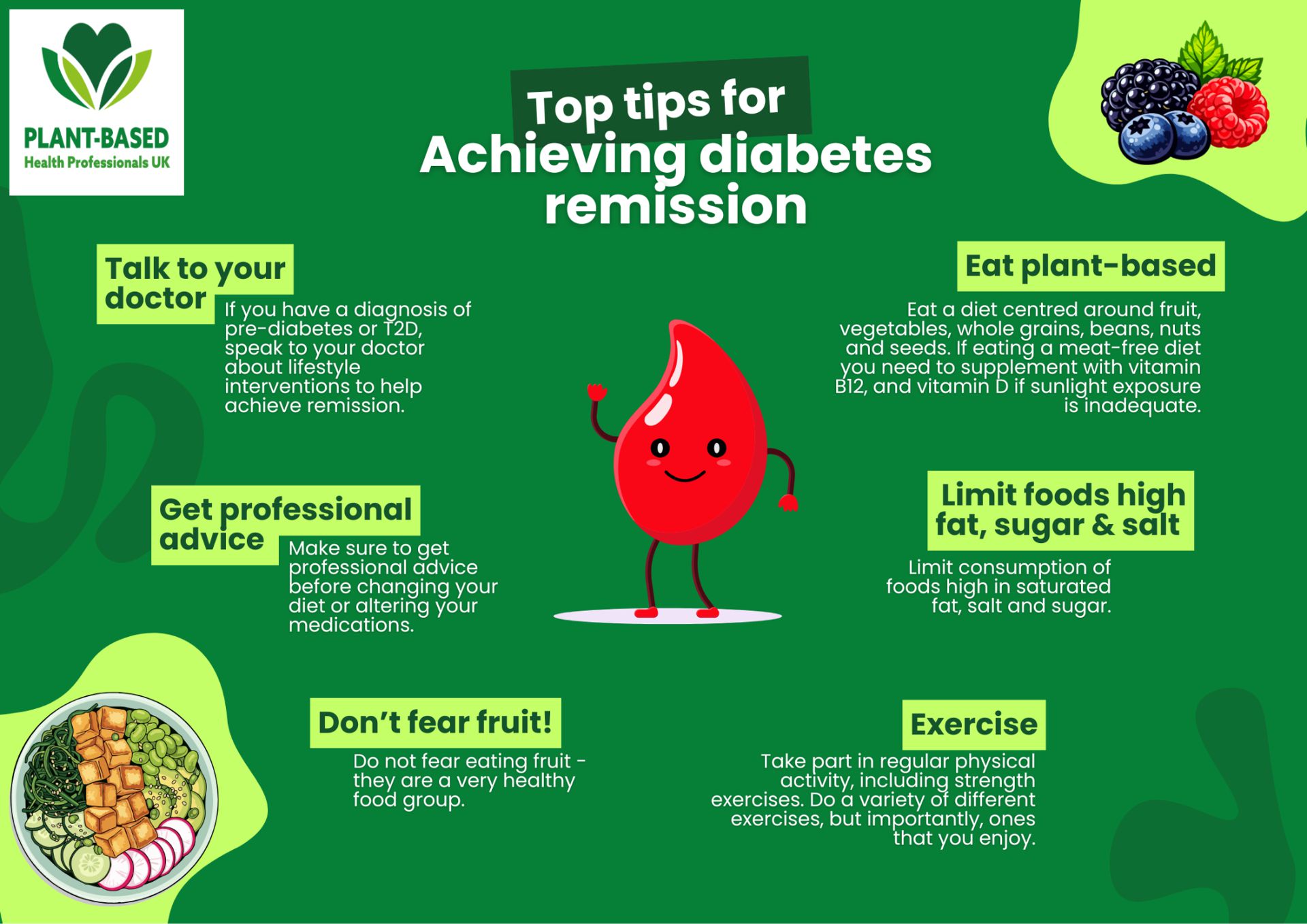
- If you have a diagnosis of pre-diabetes or T2D, speak to your doctor about lifestyle interventions to help achieve remission.
- Make sure to get professional advice before changing your diet or altering your medications.
- Eat a diet centred around fruit, vegetables, whole grains, beans, nuts and seeds. If eating a meat-free diet you need to supplement with vitamin B12, and vitamin D if sunlight exposure is inadequate.
- Limit consumption of foods high in saturated fat, salt and sugar.
- Do not fear eating fruit – they are a very healthy food group.
- Take part in regular physical activity, including strength exercises. Do a variety of different exercises, but importantly, ones that you enjoy.
Resources
Read the PBHP UK factsheet on type 2 diabetes.
NICE guidelines – Type 2 diabetes management.
American College of Endocrinology consensus statement on the management of diabetes.
Canadian Diabetes Association review of plant-based diets for diabetes.
American College of Lifestyle Medicine consensus statement on type 2 diabetes remission.
Lifestyle Interventions for Treatment and Remission of Type 2 Diabetes and Prediabetes in Adults: A Clinical Practice Guideline From the American College of Lifestyle Medicine