Everything you need to know about soya and health
By Isabelle Sadler, PBHP UK Research Assistant, MSc Nutrition Student
Introduction
Soya has been part of the human diet for thousands of years, with records suggesting it was first consumed in China more than 2,000 years ago. Since then, it has spread across Asia and, more recently, into mainstream diets in the UK, appearing in everything from tofu and edamame to soya milk and meat alternatives.
All soya foods originate from the soya bean, a nutrient-rich member of the legume family. Broadly, soya foods can be divided into fermented varieties, such as natto, tempeh, and miso, and unfermented forms, including tofu, edamame, and soya milk.
Despite its long history and growing popularity, soya remains one of the most debated foods in nutrition science. Here we summarise some of the most important, and latest, evidence on consuming soya. From the health benefits, to the myths, and best ways to eat (or drink!) it.
Soya as part of a healthy dietary pattern
Soya is widely considered a healthy food to include regularly in the diet, and is included in many recommended dietary patterns and country dietary guidelines.
The Portfolio diet is a plant-based eating pattern that is designed to lower cholesterol. It is low in saturated fat and includes specific cholesterol lowering foods, namely soya and legumes, nuts, plant sterols, and foods rich in viscous fibres such as oats and beans. A higher Portfolio Diet Score has been associated with a lower risk of cardiovascular disease, coronary heart disease, and stroke in observational studies, as well as a more favourable blood lipid and inflammatory profile.
Soya is also included in the UK Eatwell Guide, you can find fortified soya drinks in the ‘dairy and alternatives food’ group and soya proteins such as tofu and beancurd, within the ‘beans, pulses, fish, eggs, meat and other proteins’ group.
The 2025 EAT-Lancet Planetary Health Diet recommends 2-3 servings of legumes per day, which includes soya and soya products.
Phytoestrogens and isoflavones
Soya beans are a uniquely rich source of compounds called isoflavones – particularly two types known as daidzein and genistein. Isoflavones belong to a broader family of naturally occurring plant compounds called phytoestrogens, so named because they weakly mimic the effects of the human hormone oestrogen.
Isoflavones have a similar structure to the hormone oestrogen, which allows them to interact with the body’s oestrogen receptors – the docking sites that oestrogen normally binds to. However, they are not the same as oestrogen, and should not be considered equivalent. The differences matter both at a molecular level and in terms of their effects in the body.
Oestrogen receptors come in two forms: alpha and beta. Human oestrogen binds to both equally, but isoflavones show a strong preference for the beta type. This distinction is significant, because alpha and beta receptors are distributed differently across tissues in the body. By preferentially targeting beta receptors, isoflavones can have different effects in different tissues. For this reason, they are classified as selective oestrogen receptor modulators, or SERMs.
It is largely this phytoestrogen content that has given soya its controversial reputation. The belief is that these compounds might interfere with the body’s hormonal system, which has led some to think that eating soya could affect breast cancer risk, male and female hormone levels, and thyroid function. There is no evidence to suggest that soya adversely affects hormonal health in men or women, in fact studies demonstrate beneficial impacts.
Soya and health outcomes
Soya contains all nine essential amino acids in quantities that closely match human requirements and is therefore an excellent source of protein. It is also a good source of fibre, calcium, non-haem iron and omega-3 fatty acids. This combination of nutrients, alongside isoflavones, contributes to soya being a health-promoting food, and its association with a reduced risk of several chronic diseases.
Cardiovascular diseases
In 2026, a comprehensive umbrella review of meta-analyses on soya consumption and health was published. Across seven studies, regular soya intake was associated with a large reduction in incidence and mortality of cardiovascular diseases, up to 21% in one of the included meta-analyses. The two studies that looked at stroke incidence and mortality also found a reduction in risk between 18% and 12%.
This may be, in part, due to soya’s effect on cholesterol. The same review found that soya protein significantly reduces total cholesterol and LDL-cholesterol. LDL-cholesterol is linked to a higher risk of heart disease. Soya may also help lower blood pressure, providing another route through which it could support heart health.
Cancer
Research also suggests benefits for cancer risk. The same 2026 review found that regular soya consumption was associated with a reduced risk of colon cancer, gastrointestinal cancer, gynecological cancer, lung cancer, prostate cancer, and rectal cancer. A large systematic review and meta-analysis previously published in 2022 reinforced this, finding that higher soya intake was associated with a 10% reduction in overall cancer risk, with each additional 25g of soya per day linked to a 4% reduction. For site-specific cancers, lung and prostate cancers showed some of the most consistent effects for a reduction in risk. One exception worth noting is an increased risk of stomach cancer was observed in men consuming one to five cups of miso soup per day, though this is most likely due to miso’s high salt content rather than the soya itself.
On breast cancer specifically, a 2024 systematic review found that intake of soya protein and products was associated with a significantly reduced risk of breast cancer recurrence. While no association was seen for risk of breast cancer-specific mortality, a significant reduction in risk was found for estrogen receptor-positive disease in breast cancer-specific mortality. Soya foods should therefore be encouraged, even for women at high risk or with a diagnosis of breast cancer.
Soya protein has also been associated with a reduced risk of kidney disease and type 2 diabetes, better cognitive function, and improved bone health in women, suggesting that its benefits extend beyond heart health and cancer prevention.
Menopausal hot flushes
The idea that soya might ease menopausal hot flushes dates to the early 1990s, when researchers proposed that the weak oestrogen-like activity of isoflavones could help cushion the drop in oestrogen that women experience during the menopause transition. Three decades worth of clinical trials later, and the evidence is still somewhat mixed.
The majority of these trials have used isolated soya isoflavone supplements to test whether they can alleviate hot flushes, which may contribute to the wide variation in results seen in clinical trials. The supplements used can either be produced from whole soya beans with an isoflavone profile similar to that found in soya foods (genistein is the predominant isoflavone) or from the germ portion of the soya bean which is much lower in genistein. The trials using the former, with at least 20 mg genistein and 50–60 mg total isoflavones consistently show isoflavones to be efficacious for reducing the frequency and severity of hot flashes.
There has been a small, randomised study of a whole food plant-based diet with the addition of 86g of cooked soya beans in the intervention arm, compared to the usual diet in the control group. The impact on hot flashes assessed after 12-weeks showed that although both groups reported improvements, participants on a plant-based diet with added soya had a greater reduction in the frequency and severity of hot flashes.
Despite these inconsistent results, it can be argued that results are good enough to recommend the regular intake of soya as a food (not as a tablet), not least because of a number of other benefits and the absence of side effects. Soya foods should be recommended over isolated soya isoflavones where possible, as these foods are a composite of intricate biologically active molecules rather than containing just isoflavones.
Thyroid function
Scientists have been investigating the relationship between soya and thyroid function since as far back as 1933. Decades of research since then have produced a fairly clear picture: isoflavones do not affect thyroid hormone levels in people with normal thyroid function.
Even in people with subclinical hypothyroidism (where the thyroid is underactive but not yet causing obvious symptoms), or in those whose iodine intake is on the low side, current evidence suggests isoflavones are unlikely to cause significant problems.
One practical consideration does apply to people taking levothyroxine, the medication commonly prescribed for an underactive thyroid. Soya may reduce how well the drug is absorbed, though it‘s worth noting that this is also true of food in general, as well as many other supplements and medications. This does not mean people on levothyroxine need to avoid soya altogether. The simplest solution is timing. Taking the medication around an hour before eating, or waiting several hours after a meal before taking it, is enough to get around the issue. For those who eat soya regularly and consistently, another option is for their doctor to adjust their levothyroxine dose to account for it, but please note this is something for individuals to discuss with their healthcare professional.
Soya protein for muscle mass and strength
Evidence indicates that soya protein is as effective as whey and other animal proteins for supporting gains in muscle strength and lean body mass. A 2018 meta-analysis of nine studies comparing soya protein with animal proteins found that supplementing resistance training with either whey or soya protein resulted in significant improvements in strength, with no significant differences between groups. Similarly, both lean body mass and strength increased in participants consuming soya protein and those consuming other protein sources (including beef, milk, and dairy proteins), with no significant differences in outcomes between the groups.
Soya and the environment
Since the 1950s, global soya bean production has increased 15 times over. Growing soya at such a massive scale is not sustainable, and has led to vast areas of forest being burnt and cut down to make way for soya plantations. Converting forests and grasslands into farmland for soya also releases carbon dioxide and other greenhouse gases which cause climate change.
Some have blamed plant-based diets for the increase in soya production and the associated environmental damage. But that’s far from the reality. Globally, around 90% of all soya is fed to chickens, pigs and cows, and only around 5% is eaten by humans. The huge increase in soya production is therefore mostly the result of meeting the growing demand for foods made from animals. This is also true in the UK, where 90% of imported soya is fed to chickens and pigs and can be directly linked back to deforestation in the Global South. Eating soya directly is far more efficient than feeding it to animals first.
Soya allergy
While soya can be beneficial for almost everyone, those with a soya allergy need to completely avoid it. Soya is classed as one of the 14 main food allergens in the UK, and all food and drinks ingredient labels for sale within the UK must clearly state soya as an allergen.
Those with a soya allergy don’t need to worry, there are many other health-promoting foods to include in the diet instead. For more information on soya allergy, please refer to the factsheet on our website. Please consult your doctor if you suspect you have an allergy or intolerance to soya or need to avoid it for medical reasons.
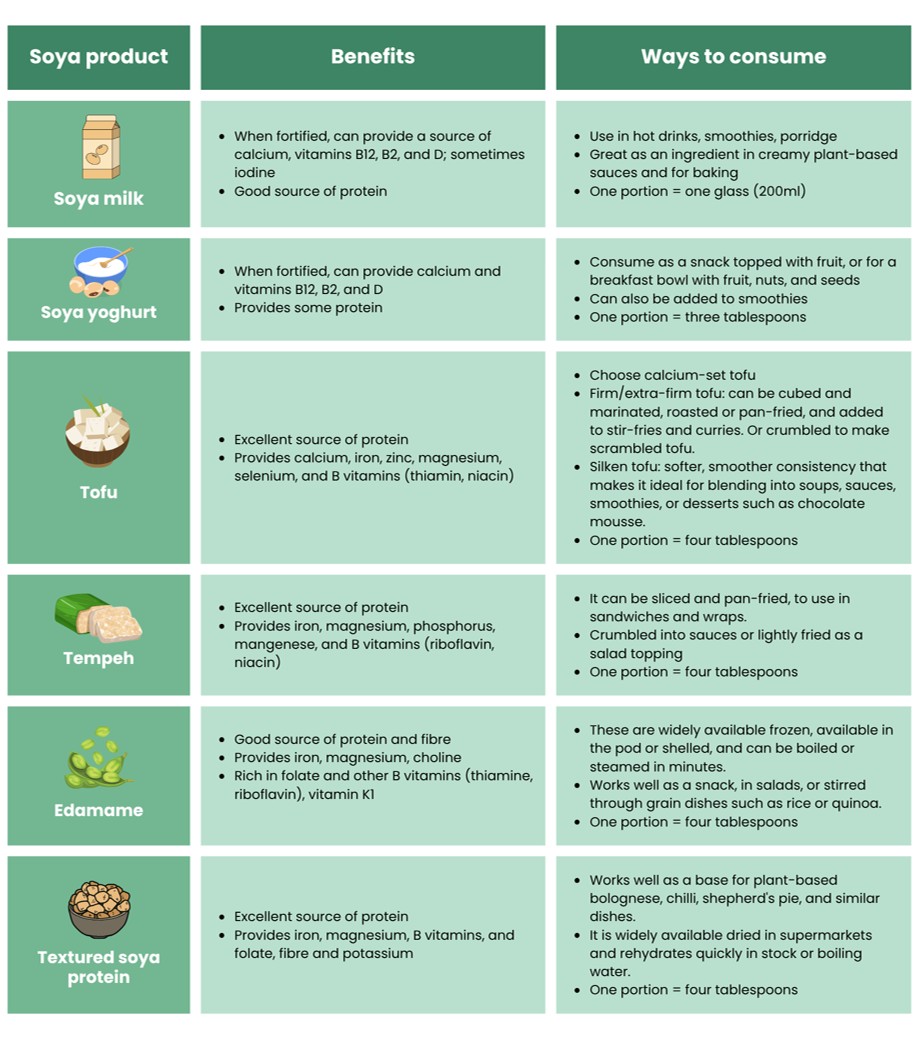
Ways to include soya in the diet
Take home points
- Soya provides a high quality protein source containing all nine essential amino acids and many other vitamins, minerals, and plant compounds, making it an excellent addition to any dietary pattern.
- Regular soya consumption is associated with many health benefits, including a reduced risk of cardiovascular disease, several cancers, as well as potential benefits for bone health, kidney health, and menopausal symptoms.
- Soya foods do not adversely affect hormonal health. Individuals with breast cancer can be reassured that regular soya intake is safe and can be encouraged.
- Soya production has significantly lower impacts on the environment compared to the production of animal-sourced foods.
- Aiming for around two portions of soya food a day is recommended, for example, a glass of calcium-fortified soya milk, 4 tablespoons of tofu, tempeh, or edamame beans.