
Everything you need to know about ultra-processed foods on a plant-based diet
By Isabelle Sadler, PBHP UK Research Assistant, MSc Nutrition Student
Navigating the world of UPFs can be confusing. What foods should we avoid and in what quantities? Much of the food available in supermarkets is processed in some way, and convenience foods can play a role in busy lives. Plus, some commonly used foods, such as plant milks or meat alternatives, are classified as ultra-processed.
Below we answer some of the most common questions we receive.
What is an ultra-processed food?
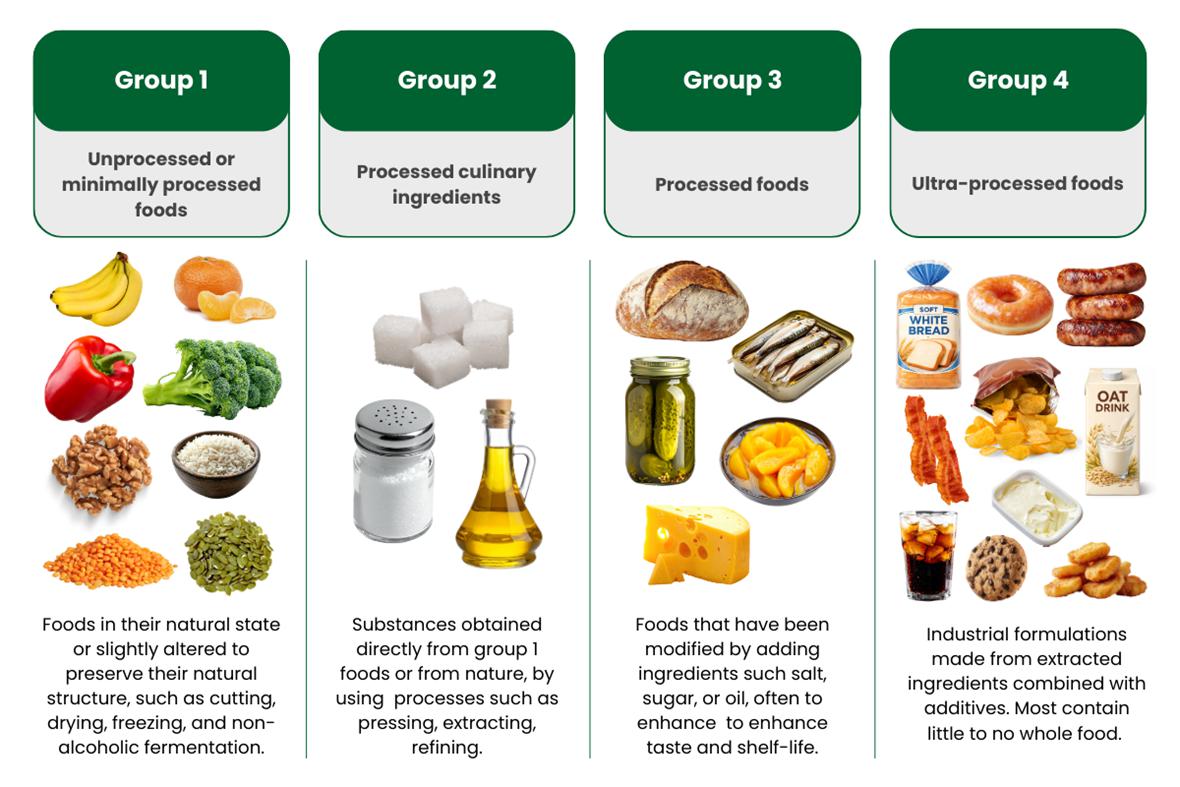
Different classification systems have been developed to describe foods by their degree of processing. The NOVA system is most commonly used, developed by researchers at the University of São Paulo, Brazil.
NOVA categorises food into four groups based on processing (see Figure 1 below). Ultra-processed foods make up group 4; these are industrial formulations, characterised by extensive processing, made from cheap industrial ingredients, and combined with additives. Flavours, colours, emulsifiers, and other additives are used to make the food look, smell, and taste good, often hyper-palatable, as well as to extend shelf-life. Examples include carbonated soft drinks, flavoured yoghurt, hot dogs, sausages, desserts, and ready-to-eat meals. Infant formulas, plant-based dairy and meat alternatives, breakfast cereals, and breads are also considered ultra-processed foods under NOVA.
While NOVA is widely used in research and public health policy work, it does receive criticism. Classification is based on the degree of processing, and not nutritional quality, which means the categorisation of foods can seem inconsistent. This can make the system confusing, and it’s not always easy to apply in practice.
Are all ultra-processed foods unhealthy?
Diets high in UPFs are generally associated with an increased risk of several chronic diseases, including cardiovascular disease (CVD), type 2 diabetes and some cancers. However, when we break this down by type of ultra-processed food, the health impacts can be strikingly different.
In 2023, a cohort study found that processed animal meats and sugar-sweetened beverages were most strongly associated with increased risk of developing cancer and cardiometabolic diseases. In contrast, plant-based meat alternatives were not associated with increased risk, and even showed a trend toward a lower risk.
More recent research has also shown that the health effects of ultra-processed foods vary depending on the type of food. A 2024 analysis of three large U.S. cohort studies, involving more than 206,000 participants followed for nearly 30 years, found that higher overall UPF intake was associated with an 11% higher risk of CVD. However, the associations differed by food category: sugar-sweetened beverages and processed meats showed consistent increased risk, while breads, breakfast cereals, yoghurts, and some savoury snacks were associated with lower CVD risk.
Similarly, a 2024 study of over 311,000 participants in Europe found that each 10% increase in UPF intake was associated with a 17% higher risk of type 2 diabetes overall. Yet again, the results varied by food type: processed animal products, savoury snacks and sweetened beverages were associated with higher risk, whereas breads, breakfast cereals and plant-based alternatives were linked with lower risk.
These foods differ greatly in their nutritional quality and ingredients, and those that are linked to lower risk of chronic diseases, such as breakfast cereals and whole-grain breads, can add valuable nutrients, including fibre, iron and B vitamins. Therefore, simply classifying them as unhealthy because of their level of processing can be misleading.
Are plant-based meat alternatives ultra-processed and unhealthy?
Based on the NOVA classification system, most plant-based meat alternatives (PBMAs) are considered ultra-processed foods. However, current evidence suggests that consuming these products may not be associated with an increased risk of chronic diseases. They may also offer health benefits over the consumption of red or processed meat.
Read our full article for more evidence on plant-based meat alternatives here.
Can I drink processed plant-based dairy alternatives?
Plant-based drinks are often classified as ultra-processed because they undergo industrial processing and may contain ingredients such as emulsifiers or stabilisers. However, they do not share many of the characteristics of ultra-processed foods that are typically linked with poorer health outcomes. For example, most are not high in salt or saturated fat, and they are not designed to be hyper-palatable or easy to overconsume. Choosing unsweetened varieties can also help avoid added sugars. Additionally, some of their processing is beneficial, such as the addition of vitamin D, calcium, and iodine.
Evidence also suggests they can support good cardiometabolic health. A systematic review and meta-analysis of 17 trials found that replacing cow’s milk with soya milk, regardless of the presence of added sugars, led to reductions in non-HDL cholesterol, systolic and diastolic blood pressure, and small reductions in LDL cholesterol and C-reactive protein. This is despite soya milk being classified as an ultra-processed food, and dairy milk being classified as minimally processed.
Consumers often perceive organic or less processed products as healthier. However, in the UK organic plant milks are typically not fortified, meaning they may lack nutrients such as calcium and iodine.
Should I be worried about emulsifiers in plant-based drinks?
Some plant-based drinks contain small amounts of emulsifiers, such as gellan gum, to improve texture and prevent separation.
There has been growing interest in how certain food additives might influence health, particularly gut health. However, at present there is not enough evidence to suggest that people without specific gastrointestinal conditions, such as irritable bowel syndrome, need to avoid emulsifiers altogether. Gellan gum, one of the most common emulsifiers used in plant drinks, is considered safe by food safety authorities and is used in small amounts.
For people living with inflammatory bowel disease, avoiding emulsifiers may be beneficial. A recent randomised controlled trial in people with mild to moderately active Crohn’s disease found that those following a low-emulsifier diet were more likely to achieve symptom improvement and remission over eight weeks compared with a control group. However, much of the existing evidence on how emulsifiers may affect the gut microbiome and intestinal barrier comes from laboratory and animal studies, and more human research is needed.
It is also important to consider overall dietary patterns. Diets high in ultra-processed foods may contain much larger amounts of emulsifiers overall. In contrast, a diet based largely on whole plant foods, with occasional foods containing small amounts of emulsifiers (such as plant drinks), is less likely to have the same impact.
For those who prefer to avoid emulsifiers, various plant milks are available without them. However, these products are not always fortified, so it is important to ensure nutrients such as calcium, iodine and vitamin D are obtained from other sources.
Read our complete guide to plant-based milks here.
What about plant-based cheese alternatives?
Plant-based cheese is also classified as ultra-processed. However, like many foods in this category, its nutritional value varies widely depending on the ingredients used.
Many commercial plant-based cheeses are made primarily from coconut oil and starches. These products can be relatively high in saturated fat and salt, typically contain little protein or fibre, and may contain a range of additives, so they fit better with the accepted definition of UPF.
However, other varieties are based on whole plant foods, such as cashews or tofu. These options tend to offer a more favourable nutritional profile. For example, cashew-based cheeses may contain more protein and unsaturated fats, and tofu-based cheeses can provide a useful source of plant protein.
Some plant-based cheeses are also fortified with important nutrients such as vitamin B12, calcium and iodine.
Do plant-based diets contain more ultra-processed foods than other diets?
Not necessarily. In fact, several studies show that consumption of ultra-processed food tends to be very similar, sometimes identical, across plant-based diets and diets that include animals.
Some studies have shown a higher intake of UPF in vegans and vegetarians, which is likely related to the fact that plant-based dairy and meat alternatives are categorised as ultra-processed. These often replace animal-based meat and dairy in the diet, many of which are considered minimally processed foods spanning NOVA groups 1-3.
A plant-based diet can be very high or very low in ultra-processed foods, depending on the choices someone makes, just like any dietary pattern. For example, a minimally processed plant-based diet may include foods such as vegetables and fruits, whole grains, beans and lentils, tofu and tempeh, and nuts and seeds. Whereas a plant-based diet high in UPFs might rely heavily on vegan ready meals, plant-based burgers or sausages, confectionery and snack foods, and sugary drinks.
What should I look out for on food labels?
Rather than focusing solely on whether a food is ultra-processed, it can be more helpful to consider its nutritional quality.
Some things to look out for include:
- High levels of added sugar
- High salt content
- High saturated fat
- Very low fibre
- High in calories
Foods that combine high sugar, salt or fat with low fibre are more likely to contribute to poorer health outcomes. This aligns with the conclusions of an evidence review by the UK Scientific Advisory Committee on Nutrition, that states most of the negative health impacts of UPFs are related to higher calorie, salt, sugar and fat intake.
You can also look at the ingredient list. Very long lists with many unfamiliar ingredients may suggest a highly processed product, although lots of ingredients does not automatically mean it is unhealthy.
Should I try to avoid ultra-processed foods completely?
For most people, the goal does not need to be complete avoidance, but rather building a diet that is mostly made up of minimally processed plant foods. Small amounts of processed foods can still fit within a healthy dietary pattern.
Practical tips for reducing reliance on ultra-processed foods
- Base meals around whole plant foods
Build meals around foods such as beans and lentils, whole grains like oats, brown rice or quinoa, vegetables and fruits, and nuts and seeds. - Swap highly processed spreads or cheeses for whole-food alternatives
Instead of relying on plant-based cheeses or spreads high in saturated fat and salt, try:
● Tahini or nut butters for creaminess
● Avocado
● Hummus or bean dips
● Nut-based pâtés
● Homemade blended cashew nut sauces
● Nutritional yeast for a savoury “cheesy” flavours
Adding flavour with garlic, herbs, spices, lemon juice or black pepper can make simple foods more satisfying. - Use plant-based meat alternatives occasionally
These products can be helpful for convenience or when transitioning to a plant-based diet, but try to include whole-food protein sources most of the time. - Choose unsweetened fortified plant drinks
There is generally no need to make your own plant milks unless you prefer to. Homemade versions are typically not fortified, which means they may lack important nutrients such as calcium and iodine. Choose varieties that are fortified and unsweetened, or try a powdered plant drink, which are often more environmentally friendly too.
Recommended reading
Ultra-processed food and cancer | World Cancer Research Fund